

26 Birthday-Themed Oral Motor and Feeding Activities
11th Aug 2026
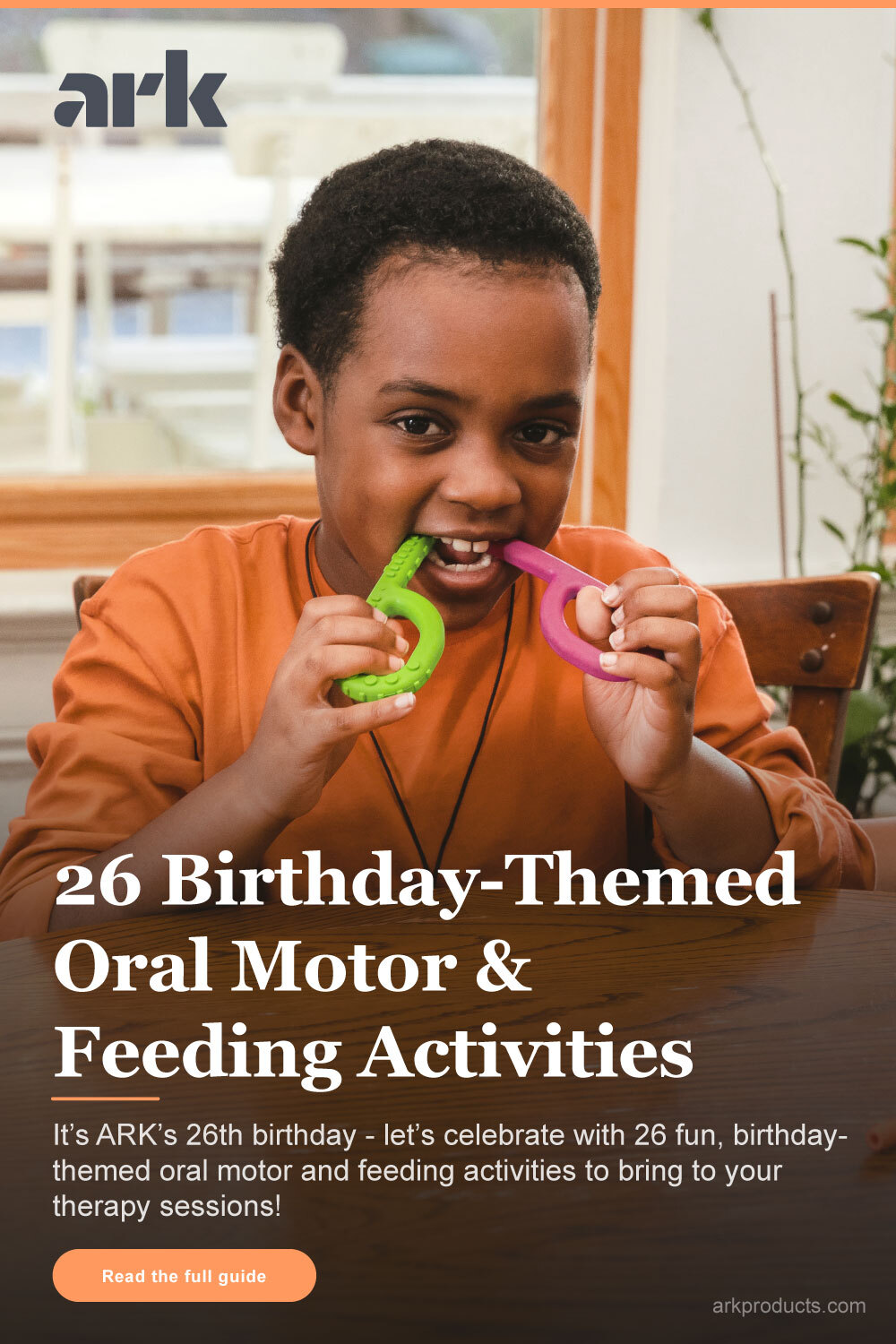
ARK turns 26 this month! In celebration, here are 26 fun oral motor and feeding activities, all built around things you'd find at a birthday party - candles, frosting, sprinkles, party blowers, cake pops, crunchy snacks, silly faces, etc.
Before you start - keep in mind that food-based activities depend entirely on the individual - allergies, textures they tolerate, and their current chewing and swallowing skills all matter, so please keep these in mind.
.
Blowing out the candles
Blowing is one of the easiest ways to work on lip rounding and graded breath control, and it barely feels like an exercise at all.
1. Blow out the "candle". Hold the Z-Vibe upright like a candle with the vibration on. When they blow, switch it off so the "flame goes out." This can help with lip rounding, and the vibration gives you a clear auditory payoff for a good strong breath. Check out tips on how to teach blowing here!
2. Relight it. Switch it back on. Blow it out again. Repeat. Trick candles are a real thing and kids find this genuinely funny.
3. Party blowers and horns. The paper roll-out kind. These need a fair amount of air pressure and a good lip seal to unroll all the way, so they work on lip closure and breath support at the same time. Kazoos and pinwheels work too.
4. Blow bubbles. An old standby for a reason. Sustained, controlled breath plus lip rounding, and you can grade it by asking for one giant bubble versus a whole cloud of small ones (depending on the type of bubbles).
5. Confetti races. Scatter paper confetti on a table and have them blow the pieces to a finish line. Add distance to make it harder. This can be a nice way to work on directing and grading breath rather than just producing it.
6. Balloon cheeks. Puff both cheeks full of air and hold for a few seconds without letting any escape, then release. Then try one cheek at a time. Then alternate back and forth. This one works the cheeks and requires a real lip seal to pull off.
Cake, frosting, and sprinkles
This is where most of the tongue work lives. Frosting, whipped cream, or anything sticky are useful because they give the tongue a reason to go somewhere specific. We have a whole post on edible oral motor exercises if you'd like more along these lines.
7. Frosting on the upper lip. Dab a little on the upper lip and have them clear it with their tongue, not the lower lip. Good for tongue tip elevation, and it doubles as practice for something practical - cleaning the lips from leftover food.
8. Corners of the mouth. Put a dab in one corner, then the other, and have them lick each side clean. Alternate back and forth to get the tongue moving laterally.
9. One sprinkle, held. Place a single sprinkle on the tongue tip and ask them to press it against the alveolar ridge just behind the upper front teeth, holding it there. Work up toward 30 seconds. You can also do this with the Fine Tip on the Z-Vibe and a cheerio. This activity helps the tongue learn where to be "on spot" to produce tongue tip sounds /t/d/n/l/.
10. Hidden frosting. Place a dab on the roof of the mouth, which they then have to suck off. This one really makes the tongue work.
11. Cheek pockets. Tuck a small amount of frosting or a few cake crumbs into the cheek and have them clear it out. Useful for cheek awareness and removing leftover food from the cheeks.
12. Lick the spoon. Place frosting on the back of a spoon or Z-Vibe or other oral motor tool, and instruct the individual to like it off with their tongue, while the jaw stays still. That tongue and jaw dissociation is a skill in its own right and is a prerequisite to certain feeding and speech sounds.
13. Squeeze the cake pop. Have them round their lips around a cake pop or lollipop and squeeze, three times, then work up to holding the squeeze for three seconds. The Popette Tip lets you attach a lollipop to the Z-Vibe if you want vibration along with it for added sensory input and awareness.
14. Kiss the cake pop. Hold it just in front of the mouth and ask for a kiss, so the lips have to purse and reach forward. Then move it slightly to one side and ask them to slide the kiss over to meet it. Repeat on both sides. This can help with lip closure and rounding.
15. Push back. Press a lollipop or the flat of a spoon gently onto the surface of the tongue and have them push up against it. Three reps. Straightforward resistance work for tongue strength.
Party snacks and jaw work
16. Count the chews. Take a bite of whatever they're eating and count how many chews it takes you to fully break it down. Then count along with them to help them get there. A lot of kids swallow before food is really broken down, and counting out loud can help slow things down.
17. Chew to the music. It's our birthday and we'll chew if we want to! Make chewing a game by pairing it with music and chewing to the beat of a song.
18. Bite and hold. Place the loop of a Grabber or a Bite-n-Chew Tip between the teeth. Bite down and hold to a count of ten, release, repeat. If ten is too many, one is fine - note where they are and aim for a little more next time.
19. Tug of war. Once they're holding a bite, gently try to pull the tool out while they hold on. Make a show of it. "You're so strong!" tends to land well, and the resistance is doing real work for jaw strength. "Don't let me get it out!" also works well.
20. Hold and move. Turn a Y-Chew so you're using the widest part of the handle and place it between the molars on one side. Have them bite and hold it there while moving the tongue tip up and down. The jaw has to stay stable while the tongue works independently, which is harder than it sounds.
21. Filled tube. Put a puréed food or frosting inside a hollow Bite Tube so that biting down releases a taste. This gives a tasty motivation. The hollow tube gives less resistance than a solid chew, which makes it a reasonable starting point for limited jaw strength.
On toughness: ARK chews come in three color-coded levels, and for jaw work the standard level is the softest starting point for someone with limited strength or low oral tone, with XT as the next step up as strength builds, and XXT the firmest. One can graduate from one to the next over time.
Party drinks
Straw drinking is one of the best all-around oral motor workouts there is. Try it right now and notice how much is happening - the lips close, the cheeks tighten, the tongue retracts. More on that in the oral motor benefits of straws.
22. Punch with a Lip Blok. A Lip Blok keeps the straw from going too far into the mouth and stops individuals from biting down on it for stability, which means the lips, cheeks, and tongue have to do the work instead. Worth using whenever straws are part of the plan.
23. Milkshake mode. Thicker liquids require more suction. Milkshakes, smoothies, juice mixed with applesauce, anything thickened. An easy way to increase difficulty without changing anything else.
24. Silly straws. The curly, loopy party kind. The longer and twistier the path, the harder the oral motor effort/workout required.
Party games
25. Popping balloons. Tongue pops - suction the tongue to the roof of the mouth and release with a pop. Call them balloons popping and see how many they can get in a row. These work tongue placement, tone, and tongue-jaw dissociation all at once, and most kids will do them for fun long after you've stopped asking.
26. Party faces in the mirror. Simon Says in front of a mirror. Big surprised "o" with the lips, then move the "o" in a circle one direction and reverse it. Huge smile. Exaggerated pucker. Puffed cheeks. The mirror gives them visual feedback on what their face is actually doing (though skip the mirror if it turns into a distraction rather than a help).
A note on picking and choosing
The repetition counts here are suggestions, not targets. They'll vary a lot from person to person, and if you only get one rep out of an activity, that's still a rep. Make a note and try for more next time.
It's important to note: almost anything can be turned into an opportunity to practice speech, feeding, and oral motor skills, and/or to learn in general. These fun birthday activities are proof of that! And when oral motor exercises look like play rather than work, all the better. .
Thanks for being part of 26 years of this. Cheers to the next 26!
Not sure which tools fit which goals? Browse our Z-Vibe kits or email our team with the skills you're targeting. We love giving recommendations.
About ARK Products — Founded by a speech-language pathologist and an engineer, ARK has spent over 25 years designing tools and resources for oral motor therapy, feeding, and sensory needs. All ARK products are made in the USA from food and medical-grade materials. Questions? Reach out anytime at support@arkproducts.com.
Related Reading:
- Fun, Edible Oral Motor Exercises for Kids
- Easy Oral Motor Exercises to Try Today
- What Is Oral Motor Therapy?
- Improving Jaw Strength and Stability
- 75 Feeding Therapy Tips and Strategies