
What Is Oral Motor Therapy?
14th Apr 2026
Oral motor therapy works on the physical skills of the mouth - the lips, tongue, jaw, and cheeks - that are needed for eating, drinking, and speech.
That's really the core of it. Those four structures have to work together with a surprising amount of precision. Eating a cracker, drinking through a straw, saying the word "elephant", etc. all require specific movements, strength, and coordination from the mouth. Most people develop these skills naturally and never think about them. But for some individuals, these skills don't develop on their own, or they develop unevenly, and that's where oral motor therapy comes in.
Think of it like physical therapy, but for the mouth. A physical therapist might work on building leg strength so someone can walk. A speech therapist works on building tongue, lip, and jaw skills so someone can eat safely, drink efficiently, or produce sounds more clearly.
.
Why the mouth is more complicated than you think
Here's a quick experiment. Take a sip of water right now and pay attention to what your mouth does. Your lips seal around the cup. Your tongue moves the liquid backward. Your throat coordinates a swallow. All of that happened in about two seconds, and you didn't think about any of it.
Now try saying "la la la" and notice what your tongue is doing. For the /l/ sound, the tongue tip has to lift to the alveolar ridge just behind your upper front teeth, and it has to do that independently (without the jaw moving up to help). That's called tongue-jaw dissociation, and it's one of the many oral motor skills that speech depends on.
The mouth is essentially a small, complex system of muscles that have to coordinate strength, movement, awareness, and endurance all at the same time. It's a sort of yoga for the mouth if you will: several muscle groups need to work together in a precise balance to hold specific "poses." When any piece of that system is weak, uncoordinated, or under-developed, everyday things like eating a meal or producing certain speech sounds to communicate clearly can become genuinely difficult.
What skills does oral motor therapy target?
When therapists talk about "oral motor skills," they're generally referring to five areas:
- Awareness. Does the person know what their mouth is doing? Some individuals have what's called oral HYPOsensitivity aka reduced sensation inside the mouth. They may not feel food sitting in their cheeks, or may not realize their mouth is open. Others have HYPERsensitivity where they're overly sensitive to textures, temperatures, or touch inside the mouth, which can make eating or dental visits really challenging. Both ends of oral sensitivities can pose challenges as you can imagine. Oral motor therapy often starts here, because you can't coordinate what you can't feel, and you can't tolerate certain interventions if it feels too intense.
- Strength. Can the jaw properly manage and chew food? Can the lips seal around a straw? Can the tongue manipulate food? These are strength questions. Weak oral muscles can show up as food particles left around the mouth, difficulty breaking down food or manipulating it in the mouth, challenges with certain food textures, drooling, open mouth posture, or trouble producing certain sounds.
- Coordination. Can the lips, tongue, and jaw work together, and also independently where needed? For example, eating requires tongue lateralization (using the tongue to move food from one side of the mouth to the other) while the jaw moves in a rotary motion to break down food. Certain speech sounds require the tongue to move precisely while the jaw stays stable.
- Range of motion. Can the tongue reach where it needs to go? Can it elevate to the roof of the mouth? Move side to side? Extend and retract? Restricted range of motion (sometimes caused by a tongue tie, sometimes by low muscle tone) limits what the mouth can do.
- Endurance. Can these skills be maintained over the course of a meal, a conversation, or a school day? Some individuals can do the right movement once or twice, but fatigue quickly. That's an endurance issue.
Who benefits from oral motor therapy?
Oral motor therapy isn't limited to one diagnosis or one age group. It's used by speech-language pathologists, occupational therapists, feeding specialists, and myofunctional therapists across a wide range of situations. Some of the most common include:
- Children with feeding difficulties: trouble transitioning to solid foods, gagging on textures, pocketing food in the cheeks, difficulty chewing or swallowing safely. These are often oral motor issues, not behavioral ones or picky eating.
- Children with speech sound difficulties: when the mouth physically can't get into position for certain sounds, oral motor therapy works on building the prerequisite skills. (A quick note: oral motor therapy builds the physical foundation - awareness, strength, coordination - that supports speech development. It's most effective as part of a broader speech therapy plan, not in isolation.)
- Individuals with Down syndrome: low muscle tone (hypotonia) is common and often affects the oral muscles, impacting feeding, speech, drooling, and tongue posture.
- Individuals with autism and/or sensory processing differences: oral sensitivities (either hypo or hyper) can significantly affect eating, oral hygiene, and willingness to try new foods or textures.
- Infants and toddlers in early intervention: babies who aren't meeting feeding milestones, who have difficulty transitioning from breast/bottle to solids, or who show signs of oral motor delays.
- Adults recovering from stroke, injury, or surgery: oral motor therapy helps rebuild the skills needed for safe swallowing and speech production after neurological events.
- Myofunctional therapy patients: individuals working on tongue posture, open mouth breathing, or tongue thrust patterns often use oral motor exercises as part of their treatment.
What oral motor therapy actually looks like
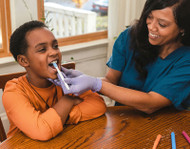
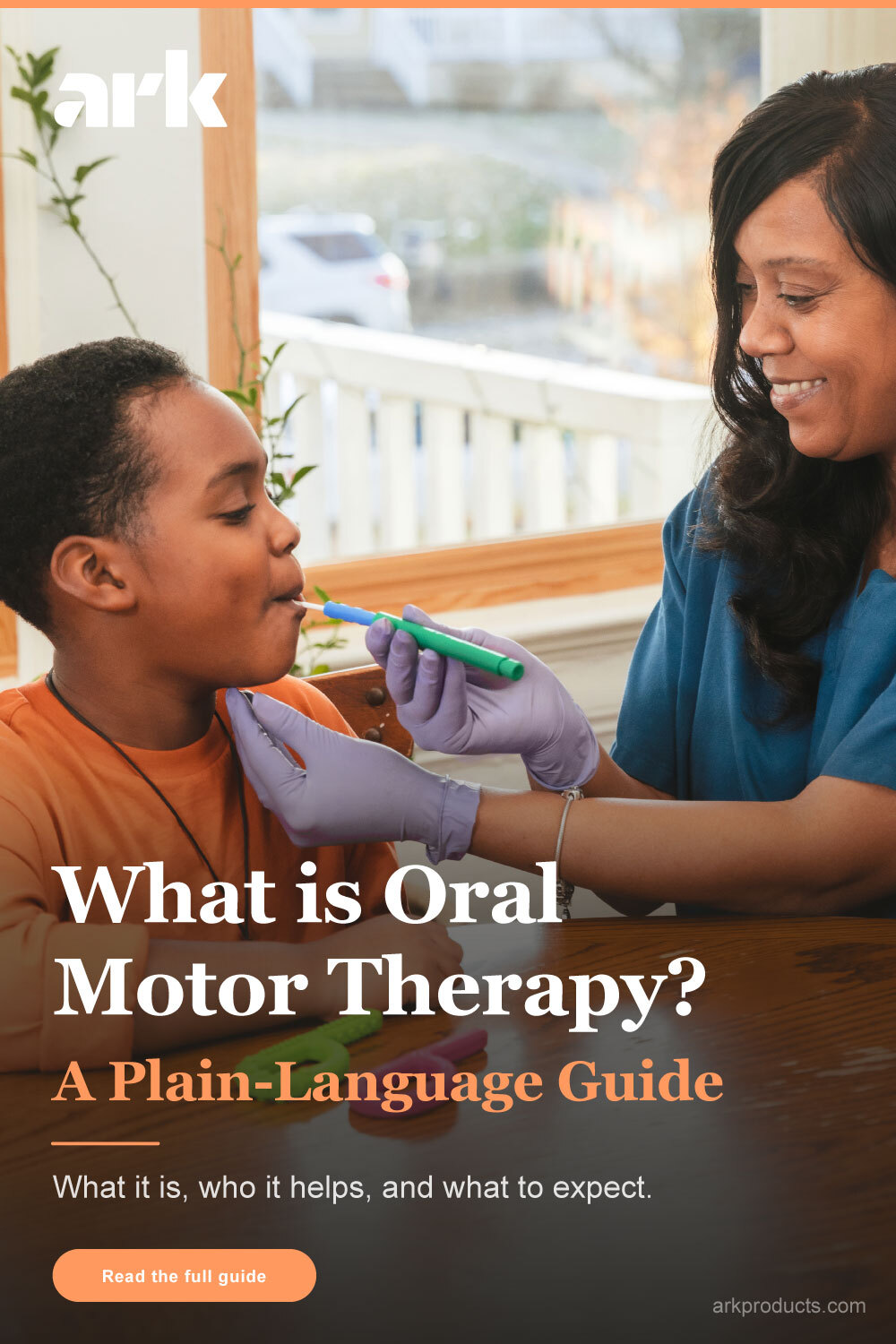
If you're picturing something that looks like a dental exam, it's usually much more approachable than that, especially with kids. Sessions might involve blowing bubbles or whistles to build lip strength. Drinking through silly straws to practice suction and lip closure. Biting and holding a chew tool between the molars to build jaw stability. Lollipop exercises for tongue elevation. Playful games that target specific movements without the child even realizing they're "doing therapy." Because fun is the language of kids, and it's important to follow their lead for the best success.
Therapists often use specialized tools to provide targeted input that fingers alone can't deliver safely or precisely. The Z-Vibe®, for example, is a vibrating oral motor tool designed to deliver tactile cues inside the mouth, showing the tongue exactly where it needs to go for a specific sound or movement. Sometimes verbal instruction ("put your tongue behind your teeth") and visual demonstration aren't enough. The sense of touch fills in the gap. Vibration takes it further by heightening sensation and drawing attention to a specific spot, which is especially helpful for individuals with reduced oral awareness.
Other common tools include oral motor probes and exercisers for targeted stimulation, straw mouthpieces that build specific skills, feeding tools designed for therapeutic use, and chew tools that build jaw strength and stability through resistive biting exercises.
The specific exercises, tools, and approach depend entirely on the individual's needs. A therapist working with a toddler on feeding readiness will use very different strategies than one working with a school-age child on tongue elevation for speech sounds. That's why a professional evaluation is always the best starting point to identify exactly which skills need support and what kind of personalized plan is needed.
Can you do oral motor exercises at home?
Yes absolutely! Therapists often encourage it. Oral motor exercises work best when they're practiced regularly, not just during weekly therapy sessions. Many of the activities are simple enough to work into daily routines: on the way to school, during snack time, while watching TV. You might see your speech or occupational therapist once per week, so following through between sessions can make progress much faster and more beneficial.
That said, home practice is most effective when it's guided by a professional who has assessed the individual's specific needs and can monitor ongoing progress. Doing random exercises without understanding the goal behind them is a bit like doing physical therapy stretches without knowing which muscle you're targeting. It might not hurt, but it might not help the way you need it to, either.
If you're looking for practical exercises to try, we have a library of posts that walk through specific skills with step-by-step guidance:
- Easy Oral Motor Exercises to Try Today — a good starting overview
- Oral Motor Exercises with the Z-Vibe® — targeted exercises using vibration and tactile cues
- Fun Edible Oral Motor Exercises for Kids — using foods as therapy tools
- Improving Jaw Strength & Stability
- Tongue Tip Elevation Exercises
- Lip Closure & Rounding Exercises
Where to start
If you think your child (or yourself) might benefit from oral motor therapy, the first step is an evaluation with a speech-language pathologist or occupational therapist who has experience in oral motor and/or feeding therapy. They can assess which specific skills need attention and build a plan from there. You don't need a diagnosis to request an evaluation — noticing that something seems off is reason enough.
For therapists and students who are building out their oral motor toolkit or for parents looking for home follow-through, our therapy kits are a practical place to start. They bundle the tools that clinicians use most frequently and are designed to cover the foundational skills outlined above. And if you're not sure which tools fit which goals, please reach out to us.
About ARK Products — Founded by a speech-language pathologist and an engineer, ARK has spent over 25 years designing tools and resources for oral motor therapy, feeding, and sensory needs. All ARK products are made in the USA from food and medical-grade materials. Questions? Reach out anytime at support@arkproducts.com.
Related Reading:
- Easy Oral Motor Exercises to Try Today
- Oral Motor Exercises with the Z-Vibe®
- 75 Feeding Therapy Tips & Strategies
Ready to explore oral motor tools? Browse Oral Motor Tools →
.