
Understanding Food/Oral Aversions and How to Help
1st Jul 2026
Mealtime should be one of the easier parts of the day. For some families, it's the hardest one.
Maybe your child clamps their mouth shut the second the spoon comes near. Maybe they gag at the sight of anything lumpy, or live on the same short list of safe foods (beige, crunchy, predictable) and panic at anything new. Maybe the food goes in and then just sits there, or gets pocketed in the cheeks with no real chewing. From the outside, it can look like pickiness or stubbornness. From the inside, for the child, it's usually something else entirely.
If this sounds familiar, you already know how tough it can be. The worry about growth and nutrition, the mealtime standoffs, the well-meaning relative who insists "he'll eat when he's hungry enough." It can feel isolating, and it can quietly make you second-guess yourself. So let's start here: a child who refuses food this way is almost never being difficult on purpose. For many of them, eating genuinely asks more of their mouth than it can comfortably handle.
.

What "oral aversion" actually means
Oral aversion is a catch-all term for a strong resistance to having things in or around the mouth. Food, utensils, toothbrushes, sometimes even drinks. Underneath it, there's often a sensory reason.
Think about everything a single bite asks of the mouth at the same moment. Temperature. Texture. Taste. The way food shifts and changes as it breaks down. Take a bite of food as an experiment and really focus on all of the different sensory variables as you eat it from first bite through to the swallow. For a mouth that processes sensation differently, that's a flood of information all arriving at once.
Some children are over-responsive. Their mouth feels ordinary input as too much, even alarming or painful, so refusing it feels like the safest option. Others are under-responsive, with low oral awareness. They don't fully register food in their mouth, which can lead to stuffing or pocketing, or simply losing track of where the food is (imagine chewing food without being able to fully feel it in your mouth!). Plenty of kids land somewhere in between, or shift from day to day and food to food. AND this can sometimes vary by different parts of the mouth.
Not every feeding difficulty is sensory related, however. Reflux, oral motor delays, structural differences, medical history, a negative past experience with a certain food, and more can all play a role, sometimes more than one at a time. That's exactly why an evaluation with a feeding professional matters.
Where vibration comes in
One of the more effective ways to help a guarded or tuned-out mouth is, somewhat counterintuitively, to give it more sensory input rather than less. Introduced gradually, in a way the child can tolerate, that input helps the mouth get used to sensation instead of bracing against it.
Vibration is one of the best ways to deliver it, and it's exactly what the Z-Vibe was built around. The Z-Vibe is a vibrating oral motor tool that brings gentle, steady input to the lips, cheeks, tongue, gums, and jaw. That vibration does two useful jobs depending on the child. For an over-responsive mouth, it's a predictable, repeatable sensation that can be introduced slowly to build tolerance over time. For an under-responsive mouth, it does the opposite work: It's alerting enough to "wake up" an area that usually gets ignored, so the child actually starts to notice what's happening in their mouth.
Feeding therapists lean on this regularly to help decrease oral defensiveness and sensitivity, both before meals and during them. The goal isn't to force anything. It's to help the mouth feel ready.
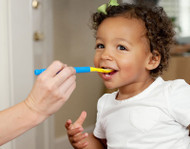
What makes the Z-Vibe especially handy for feeding is that the tip on the end can change. Swap the standard Probe Tip for a spoon or fork tip (you'll find these and other feeding therapy tools in one place) and the same vibration that's been waking up or calming the mouth now arrives attached to an actual bite of food. For a child who refuses a regular spoon, that familiar, gently buzzing tool can be a far less threatening way in. More than a few parents have described the moment their child accepted food from the Spoon Tip when nothing else had worked, sometimes finishing a meal for the first time in memory.
Starting slow, and following the child's lead
A few principles tend to make this go more smoothly:
- Start away from the mouth. Vibration can be a surprise at first. It's very alerting. Many therapists therefore introduce it on the hands or arms, then the cheeks, working toward the mouth only as the child stays comfortable.
- Follow the child's lead. If the child grimaces, pulls back, or pushes the tool away, discontinue using it. Look for nonverbal cues. Ideally you want to ease off before you reach the point of refusal, and pick back up just below it next time.
- Short and frequent beats long and rare. Brief moments of input throughout the day are usually easier than one big session.
Progress, not an overnight transformation
Feeding challenges rarely resolve in a weekend - what's realistic is gradual change. A mouth that braces a little less, a child who tolerates one new texture, then another, working up to an easier mealtime. Some kids take to vibration right away, while others need some time to warm up to it. Both are completely normal reactions.
Remember that feeding therapy is a marathon, not a sprint. Celebrate every milestone big and small, because every step in feeding therapy is HUGE.
For any parents reading this - An evaluation with a feeding therapist can help pin down what's driving the refusal, what to do about it, what tools can be helpful, and more.
About ARK Products — Founded by a speech-language pathologist and an engineer, ARK has spent over 25 years designing tools and resources for oral motor therapy, feeding, and sensory needs. All ARK products are made in the USA from food and medical-grade materials. Questions? Reach out anytime at support@arkproducts.com.
Related Reading:
- 75 Feeding Therapy Tips & Strategies
- The Right and Wrong Way to Spoon Feed
- Explore ARK's feeding therapy tools